
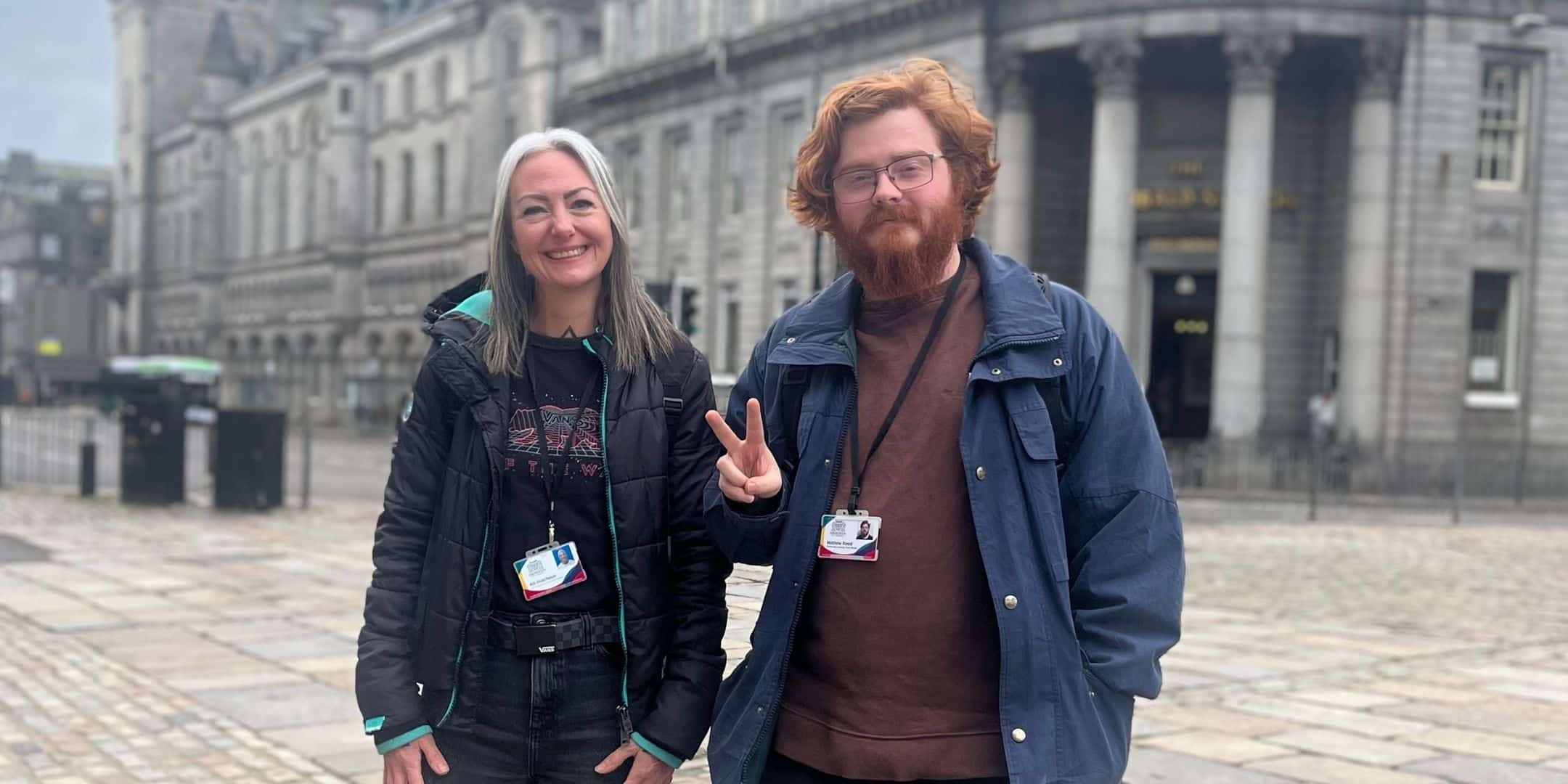
Alli Hutcheon and Mat Reed make up the Aberdeen City Council street youth work team and have been working together since last September: “We’re not aware of there being any street work in Aberdeen in the way that we do it: city centre-based, direct engagement with young people,” they say.
At first glance, the role might sound straightforward – focused on addressing antisocial behaviour and encouraging young people to make positive choices. However, when the team stepped onto the streets, they quickly learned the true complexity of the work involved.
Alli reflects on that early realisation, sharing: “We came in with an idea of what we’d be doing and it quickly proved to be much more in depth than just going out and chatting to kids.
“In just a few months we’ve spoken to 144 young people, mainly aged between 12 and 17. Only recently have we started to see familiar faces – they’re starting to recognise us. It’s great because it creates consistency and familiarity.”
A core principle of their approach is simple – meeting young people where they’re at: “You don’t come with judgement or predetermined opinions. You accept who they are and work from there,” Mat says.
That philosophy extends to how Alli and Mat present themselves. Unlike police or city wardens, they don’t wear uniforms.
Mat continues, saying: “When police or city wardens arrive, young people see the uniform first rather than just the person. We wear plain clothes, which really knocks down that barrier.”
The first thing that Alli and Mat say when approaching a group is: “Don’t worry, you’re not in trouble.” They share that this simple reassurance immediately helps young people relax and encourages them to talk, setting the tone for the support that the street youth work team can offer.
Alli explains:
“We’re not their parents or the police, we can’t stop them doing anything but we can try to make sure they’re safe.”
As part of their work, the team have also been attending under-18 events in the city centre. They arrive early to check in with young people: “We ask them questions such as ‘do you know how you’re getting home? Are you with your friends?’ – It’s making sure the young people are safe and have a plan for the evening,” says Alli.
Some young people have told the team that without events like this, they’d just be at home doing nothing. That sense of limited options comes up frequently in their day-to-day work.
Mat explains the broader context behind what they see on the streets, saying: “A big perception among young people is that there’s nothing to do and nowhere to go. That’s why they sit in shopping centres or at the gardens.”
While acknowledging that there is a lack of provision in the city centre, the team sees part of their role as connecting young people to existing opportunities – particularly those run by third sector organisations.
“It’s important for us to speak with organisations, businesses and people who can provide something for young people in the city.”
“We act as a bridge,” Alli emphasises.
The team is now mapping what safe spaces already exist in the city centre and asking what a ‘safe space’ really means from a young person’s perspective: “Is it comfy sofas and somewhere to charge their phone? A hot drink and somewhere to hang out? Somewhere they’re welcomed rather than seen as causing trouble?”
“In an ideal world, it would all be under one roof,” the team says, referring to the idea of a dedicated youth hub. Instead, the focus is on collaboration – helping young people access the spaces that already exist.
The preventative aspect of the job often begins with simple questions. Mat says: “We ask ‘what are you doing, what’s the plan?’ Sometimes the answer is just ‘we’re hanging out.’ Other times it’s ‘there’s nowhere else to go, we got kicked out of somewhere.’”
“It’s one of those jobs that gets into your soul because you really care about it. If we’ve spoken to 144 young people and make a difference to just one, it makes it all worthwhile.”
For Alli and Mat, the impact is seen in small but meaningful ways: “We’ve had fist bumps from young people when we’ve seen them out,” they say. “Even when we’re not technically on the clock, it doesn’t really stop. It’s one of those jobs that gets into your soul because you really care about it.”
Alli and Mat share that their posts are not permanent, with funding in place for only a few more months. To ensure this vital work can continue and build on the relationships and progress already made, continued funding is essential.
As the only two street youth workers covering the city centre, Alli and Mat are realistic about the scale of the challenge: “We sometimes wonder how much impact we can make in a short amount of time. However, if we’ve spoken to 144 young people and make a difference to just one, it makes it all worthwhile.”
Above all, they emphasise partnership: “If any third sector organisation has something available for young people, we’d encourage them to share that information with us. Whether it’s a youth café, a safe space, an information hub – anything at all – please get in touch.”
By working together, the city can build a stronger support network, reaching more young people and giving each of them a chance to thrive.
To find out more and to contact the street youth work team, email: alhutcheon@aberdeencity.gov.uk / mareed@aberdeencity.gov.uk
This article originally appeared in the March 2026 edition of ACVO News, our free monthly digital magazine for and from the the third sector in Aberdeen. Read the current and past editions, and sign up to our mailing list, at acvo.org.uk/acvo-news